
Novel Ultra-Short Pulse Laser Techniques for NIR Optics
Point of contact: Dr Richard Carter
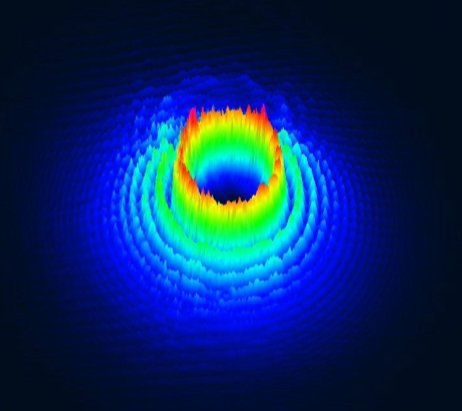
Unlike physical optics a Spatial Light Modulator (SLM) can be re-programmed on the fly and hence provide full flexibility when exploring the capabilities of different optical “shapes” (phase profiles) to provide desirable laser-material interactions.
Traditional use of an SLM involves creating the Fourier transform of a desirable beam profile. When this is focused onto a target via a lens this results in an inverse Fourier transform and the desired intensity is created at the focal plane. However such 2D beam shaping is limited, particularly when considering Ultra-Short pulse lasers where the focal volume rather than the focal plane is required to allow for full control over the laser-material interactions. This is a critical consideration when manufacturing in transparent materials including glass and optically important crystal materials like lithium niobate and zinc selenide.
To realise full 3D beam shaping we will explore the application of a technique not previously applied to manufacturing, relying on two optically active surfaces. This principle has been explored in theory but has not been applied to laser based manufacturing where we believe it has the potential for revolutionary new manufacturing processes.
Equipping our laser facility with these SLMS will allow for a series of experimental work packages to explore the capabilities of full 3D beam manipulation in ultra-short pulse laser-material interactions.
This work is part funded by AFRL via EOARD Award Number FA8655-24-2-7054
Collaborators: Calum Ross (HWU), Richard McCraken (HWU), Savash Fikretov (HWU), AFRL Electro-Optics/Infrared Components Branch
Richard Carter
Project Lead

Samuel McKenna
PhD